
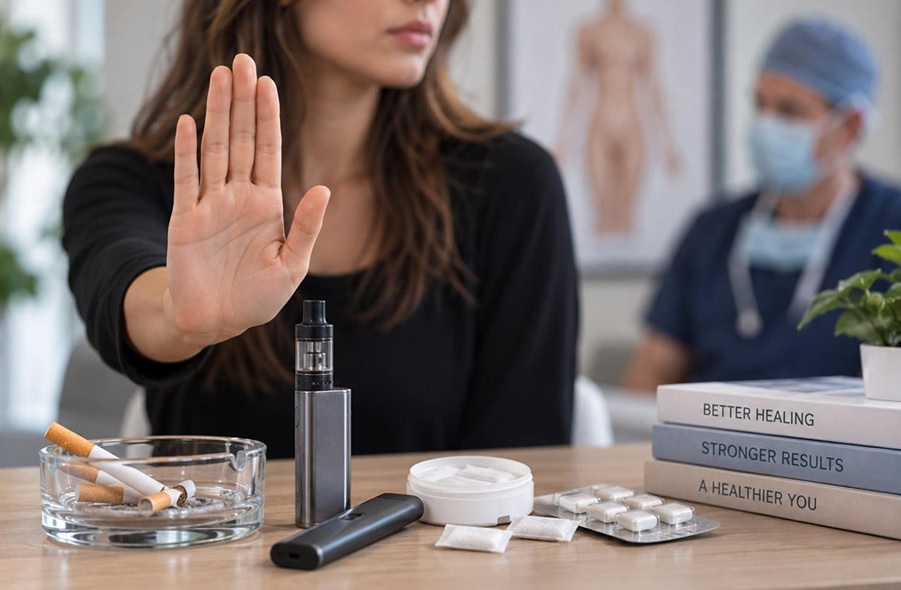

Smoking and surgery interact badly because nicotine narrows the small blood vessels that keep surgically lifted skin alive. Cigarettes, vapes, pouches, gum, and patches all deliver it. Published data show markedly higher rates of tissue necrosis, infection, and delayed healing. Most surgeons ask for several weeks of complete nicotine abstinence before and after surgery, and many verify it.
Almost every consultation covers scars, downtime, and cost. Far fewer cover the one modifiable factor that most reliably changes how a result heals. Smoking and surgery are a poor combination, and the reason has less to do with lungs than with millimeter-wide blood vessels in skin that has just been lifted, moved, and stitched back down.
This is a conversation board-certified plastic surgeon Dr. Siamak Agha and the team at The One Plastic Surgery Center in Newport Beach have with patients regularly, and it is rarely the one patients expect. Many people who would never call themselves smokers are still using nicotine daily through a vape, a pouch, or a lozenge. The risk follows the nicotine, not the label on the package, and surgeons treat the two the same way. Here is what the published evidence shows, which procedures are most affected, and what a realistic quit plan looks like.
Smoking and Surgery: What Nicotine Does to Blood Flow
Nicotine is a vasoconstrictor. It narrows small blood vessels, which reduces how much oxygenated blood reaches the skin. Surgery already divides some of those vessels, so the tissue depends on whatever supply remains. Narrow those remaining vessels, and healing slows, or tissue dies.
The American Society of Plastic Surgeons describes the effect vividly in its explanation of how nicotine sabotages plastic surgery, comparing well-perfused vessels to wide straws that shrink to the width of coffee stirrers. Less oxygen reaches the tissue, and cells at the far edge of the repositioned skin are the first to suffer.
Carbon monoxide from combustion makes the situation worse by displacing oxygen on hemoglobin, so the blood that does arrive carries less of what the tissue needs. Smoke also impairs the inflammatory cells that clear bacteria and rebuild tissue. That combination is why surgeons talk about smoking as a healing problem rather than a lung problem.
Why Vaping, Pouches, and Patches Count Too
If a product contains nicotine, it constricts blood vessels. Vapes, nicotine pouches, chewing tobacco, gum, lozenges, and transdermal patches all deliver the same active compound that causes the perfusion problem, even when there is no smoke involved at all.
ASPS has addressed electronic cigarettes directly. Reviewing the evidence, the society concluded that patients should stop using e-cigarettes before plastic surgery, advising cessation about four weeks beforehand, the same way cigarettes are handled. Many vape liquids contain nicotine at concentrations that rival or exceed cigarettes.
Nicotine replacement products deserve a specific mention, because patients often assume a patch is the safe alternative. For quitting in general, it is. For the perioperative window, it still delivers the vasoconstrictor your tissue cannot afford, so the timing and product choice need to be discussed with your surgical team rather than assumed.
“The risk follows the nicotine, not the delivery device. Vapes and pouches are not a loophole.”
The Procedures Where the Risk Climbs Highest
Operations that lift, undermine, and reposition large areas of skin carry the most nicotine-related risk, because the relocated tissue depends entirely on the small vessels left intact. Facelifts, tummy tucks, breast lifts, and body lifts sit at the top of that list.
A 2024 systematic review and meta-analysis in plastic surgery examined smoking outcomes procedure by procedure across aesthetic surgery. For facelift surgery, smoking was associated with roughly triple the odds of complications overall and a dramatically elevated odds ratio for skin necrosis, meaning death of skin at the incision edges.
The body contouring numbers were also striking. Abdominoplasty showed higher odds of infection and delayed wound healing among smokers, lower body lift showed substantially higher overall complication odds, and breast reduction showed roughly double the complication odds with elevated wound separation. That is why nicotine comes up early when discussing a facelift in Newport Beach, a tummy tuck, or a breast lift.
Smoking and Surgery: What the Broader Evidence Shows
Across all surgical specialties, smokers experience more wound complications than nonsmokers, with tissue necrosis showing the largest difference of all. This phenomenon is not specific to cosmetic surgery, which is part of why it is taken so seriously.
A large systematic review and meta-analysis of wound healing and infection in surgery, covering 140 cohort studies and four randomized trials, reported substantially higher odds among smokers for wound and tissue necrosis, surgical site infection, delayed healing and wound separation, and hernia formation. Necrosis carried the highest odds ratio in the analysis.
The American College of Surgeons reaches a similar conclusion in its statement on tobacco use and surgical complications, noting that impaired oxygen delivery to surgical wounds improves within four to eight weeks of stopping and that there is no evidence short-term cessation causes perioperative harm.
Smoking and Surgery: How Long Before and After You Must Stop
Most guidance calls for stopping all nicotine roughly four to eight weeks before surgery and continuing for at least four weeks afterward, since healing continues long after the incisions are closed.
ASPS guidance on managing the risks of smoking in plastic surgery patients recommends cessation four to eight weeks preoperatively, with timing adjusted to the patient and the procedure, and at least four weeks postoperatively. Practice-level advice often lands in a similar range, and permanent cessation is always the better outcome.
The postoperative half matters as much as the preoperative half, and it is the part patients most often shorten. Blood supply to relocated skin continues to reorganize for weeks after surgery. A single return to nicotine during that window can produce exactly the complication the wait was meant to prevent.
- Stop all nicotine products at least four weeks before, longer where advised
- Include vapes, pouches, gum, lozenges, and patches unless your surgeon directs otherwise
- Continue abstinence at least four weeks after surgery
- Avoid enclosed spaces with secondhand smoke during the same period
- Tell your surgeon immediately if you slip, rather than hiding it
Nicotine Testing, Cannabis, and Secondhand Exposure
Nicotine testing has become routine at many practices. ASPS guidance notes that surgeons may obtain a urine cotinine or nicotine test the day before or the day of surgery and postpone the procedure if it is positive. Cotinine is a breakdown product of nicotine and stays detectable longer than nicotine itself, which is why quitting the week of surgery does not pass.
Cannabis is a separate and underdiscussed issue. A study presented by ASPS found that aesthetic surgery patients who use marijuana had elevated nicotine and cotinine levels, including some who did not report using nicotine products, and that most did not mention their use during consultation. Smoked cannabis also carries its own combustion byproducts and airway irritation concerns relevant to anesthesia.
Secondhand exposure counts as well, particularly for people who live with a smoker or work around smoking. It is a smaller exposure than smoking directly, but it is not zero, and the weeks around surgery are the wrong time to test that margin. Ask household members to smoke outdoors during your recovery.
“Cotinine lingers for days. Quitting the week of surgery does not clear a nicotine test.”
How Surgeons Handle Patients Who Uses Nicotine
Honesty here is treated as clinical information, not as a character judgment. Surgeons ask about nicotine because the answer changes the plan and sometimes changes the operation. A patient who cannot stop may be offered a less extensive technique with less undermining or advised to postpone until cessation is achieved.
Support is part of the conversation. The CDC’s guidance on how to quit smoking points to free quitline coaching at 1-800-QUIT-NOW and notes that counseling combined with medication gives the best chance of quitting for good. Prescription options and nicotine replacement both have a role, though the timing of replacement products around surgery needs your surgeon’s input.
Some practices also work on the oxygen side of the equation. The One Plastic Surgery Center offers hyperbaric oxygen therapy for surgical recovery, which aims to raise dissolved oxygen in blood and tissue. It complements standard postoperative care and is not a substitute for stopping nicotine.
Key Takeaways
- Nicotine narrows the small vessels that keep surgically lifted skin alive, which is why smoking and surgery are a poor combination.
- Vapes, pouches, chewing tobacco, gum, lozenges, and patches all deliver nicotine and carry the same perfusion concern.
- Published meta-analyses link smoking to substantially higher odds of tissue necrosis, infection, and delayed wound healing.
- Facelift, tummy tuck, breast lift, and body lift procedures carry the most nicotine-related risk because of wide skin undermining.
- Most guidance calls for four to eight weeks of complete cessation before surgery and at least four weeks afterward, and testing is common.
Results and candidacy vary from patient to patient. Only an in-person consultation with a board-certified plastic surgeon can determine whether a given procedure is appropriate for you.
Giving Your Result the Blood Supply It Needs
Surgical technique sets the ceiling on a result. Tissue perfusion decides whether you reach it. Nicotine is the one variable in that equation a patient fully controls, and stopping it well before surgery and staying off it afterward is among the most useful things anyone can do for their healing.
Ready to talk through your goals and build a realistic preoperative plan, including a nicotine timeline that fits your procedure? Schedule a consultation with board-certified plastic surgeon Dr. Siamak Agha at The One Plastic Surgery Center in Newport Beach to discuss your options and what safe candidacy would require in your case.
Frequently Asked Questions
Is vaping safer than smoking before surgery?
Not in the way that matters here. The vasoconstriction that threatens healing comes from nicotine, which most vape liquids contain, often at high concentrations. ASPS advises stopping e-cigarettes about four weeks before surgery, the same guidance given for cigarettes.
How long do I have to quit nicotine before plastic surgery?
Most guidance recommends stopping all nicotine four to eight weeks before surgery and continuing for at least four weeks afterward, with the exact timeline set by your surgeon and your procedure. Impaired oxygen delivery to wounds improves within roughly four to eight weeks of stopping.
Can my surgeon tell if I have been using nicotine?
Often, yes. Many practices order a urine cotinine or nicotine test the day before or the day of surgery, and cotinine remains detectable for days after the last exposure. A positive result can lead to postponement, which is a safety decision rather than a punishment.
Does nicotine gum or a patch count as quitting?
For general smoking cessation they are useful tools, but they still deliver nicotine and therefore still constrict blood vessels. Around surgery, most surgeons ask that replacement products be stopped as well. Discuss timing with your surgical team instead of deciding on your own.
What about cannabis before surgery?
It should be disclosed. Research presented by ASPS found that aesthetic surgery patients who use marijuana had elevated nicotine and cotinine levels, sometimes without reporting nicotine use, and smoked cannabis carries its own combustion and airway concerns relevant to anesthesia.